
My Cart: 0 item(s)
Find the Perfect Coffee Grind for Espresso, Moka & Drip/Filter
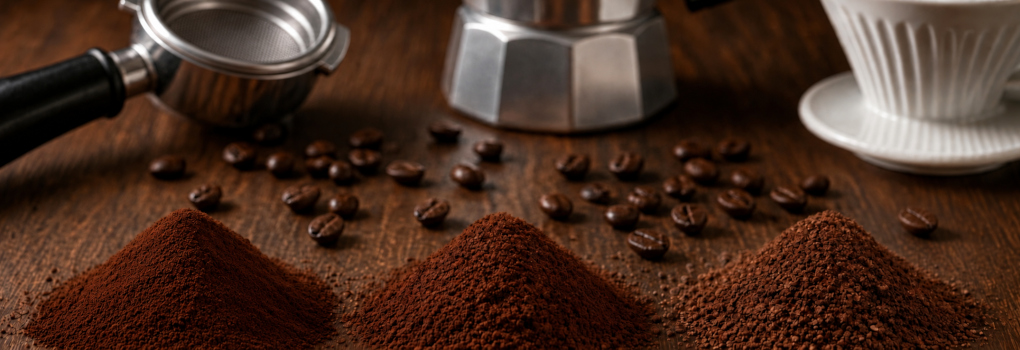
Have you ever invested in premium coffee, only to end up with a cup that tastes unpleasantly bitter or disappointingly watery? Often, the fault lies not in the roast, but in the grind size.
In this technical guide, we explore how particle size shapes your brew's chemistry and how to choose the ideal grind for Espresso, Moka pot, and Filter methods.
What is grind size and why is it fundamental?
In the world of coffee, grind size is one of the most important technical variables, second only to raw material quality. It is not simply about how "fine" or "coarse" the powder is, but how the coffee interacts with water during extraction.
In practical terms, grind size refers to the diameter of the ground coffee particles. This directly influences the speed at which water extracts the aromatic substances (oils, sugars, and acids) responsible for the final taste in the cup as follows:
- Surface Area: A finer grind increases the surface area exposed to water, speeding up extraction of the coffee’s compounds.
- Water Resistance: A fine powder slows the flow, while a coarser one speeds it up.
Essentially, grind size controls the contact time between water and coffee.
The Barista’s Golden Rule: If the coffee is too fine, it will be bitter (over-extraction); if it is too coarse, it will be acidic and weak (under-extraction).
Espresso grind: fine as powdered sugar
Espresso is the most technical and sensitive extraction method. It works with high pressure (about 9 bar) and very short times, generally between 25 and 30 seconds. For this reason, it requires a very fine grind.
The ground coffee should have a consistency similar to slightly grainy powdered sugar: thin, compact, and uniform. This structure creates the so-called "cake" through which water is forced to pass slowly, extracting aromas, oils, and body in a balanced way.
A practical tip: If the espresso comes out too slowly or in drops, try a slightly coarser grind. If it flows too quickly, you need a finer grind.
Moka pot grind: the Italian balance
The Moka pot is one of the most common methods in Italian homes, but it is often undervalued from a technical point of view. Unlike espresso, it runs at lower pressure (about 1–2 bar) and higher temperatures, making grind management even more delicate.
The ideal grind size is medium, similar to fine table salt: coarser than espresso, but still compact.
A grind that is too fine creates excessive resistance to water flow, increasing internal pressure and leading to an aggressive extraction. The result is a coffee with bitter, sometimes metallic notes. Conversely, a grind that is too coarse produces a weak and thin drink.
Filter and pour-over: aromatic complexity
Filter methods (such as V60, Chemex, or Drip Coffee) rely on gravity and longer extraction times, generally between 3 and 5 minutes. In this case, use a medium-coarse grind, similar to sea salt or ground pepper.
Because water passes through the coffee slowly, a grind that is too fine risks clogging the filter, causing over-extraction and a cloudy, bitter drink. A coarser grind, however, allows for a steady flow and a more controlled extraction, enhancing the most delicate aromatic notes.
Which grind size should you choose?
| Extraction Method | Grind Size | Consistency | Recommended Pre-Ground Product |
|---|---|---|---|
| Espresso | Very Fine (200-300 micron) | Powdered Sugar | Gusto Espresso |
| Moka | Medium (400-600 micron) | Fine Salt | Gusto Classico |
| Drip/Filter | Medium-Course (800-1,000 micron) | Sea Salt | Americano Premium |
Coffee quality depends not only on the blend but also on how it is extracted. Grind size is your main tool to control this process: it determines the contact time with water and, consequently, the balance between sweetness, acidity, and bitterness.
Even the best coffee, without the proper grind, cannot express its true potential.